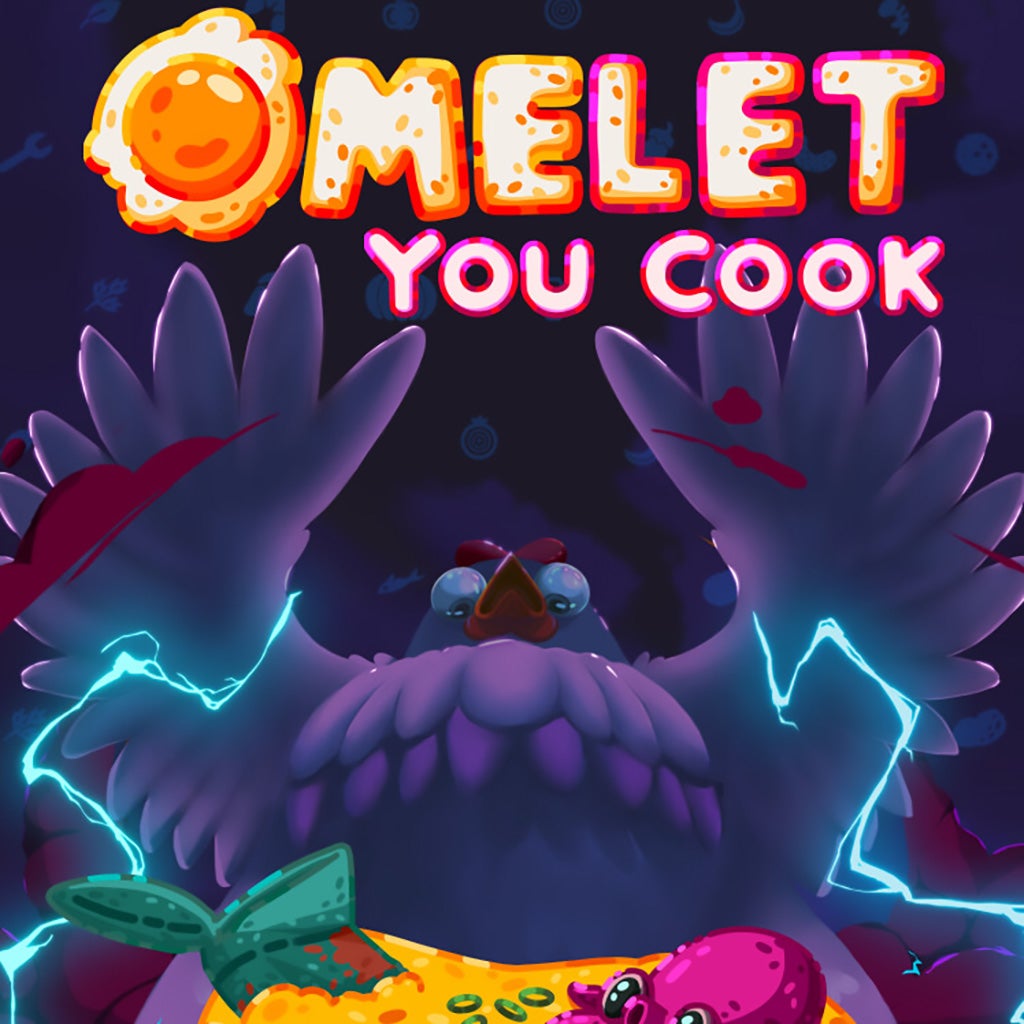
Ten days ago, a game called Omelet You Cook was officially released. Within just one week, it sold 37,000 copies. Why does a game that simply places different ingredients on an omelet to gain points feel so captivating that I cannot stop playing? Like Balatro, which burst onto the scene in 2024 and won five TGA awards, the answer lies in its multiplier mechanics.

In Omelet You Cook, whenever the player places a piece of bacon on the omelet, they gain 2 points. When the player makes a bell pepper touch any meat, the bell pepper gains 3 points per meat touching it. In other words, if there is a bell pepper touching a bacon, the player receives 2 points from the bacon and 3 points from the bell pepper, totaling 5 points.


The goal of the first level is to reach 10 points using only bell peppers and bacon. I could place five pieces of bacon and get 10 points. But I could also take advantage of the touching mechanic: by arranging three pieces of bacon and two bell peppers and letting them touch each other, I would get 6 points from the bacon and 15 points from the bell peppers, for a total of 21 points. That is more than double the original 10-point combination.


Weber–Fechner law
Mathematically, the difference between 10 and 21 is just 11 points. But psychologically, it feels far more dramatic than that. It feels like a breakthrough. It feels like discovering a hidden system. And that feeling is not accidental.

This is McDonald’s Double Cheeseburger. It costs $3.99. If tomorrow you walk into McDonald’s and find that its price has doubled to $7.98, you would likely be shocked at how expensive it has become. But if your annual income increases from $60,000 to $60,003.99, which is the same $3.99 increase, you would barely notice. For a Double Cheeseburger, adding $3.99 to the price means a 100% increase. But for your annual income, adding $3.99 is only a 0.00665% increase. This is explained by the Weber–Fechner law. It suggests that our perception scales with relative change rather than absolute magnitude. A multiplier is, by definition, a proportional change. It transforms “+11 points” into “more than double.” That shift in framing is powerful.

Peak–End Rule
Beyond our sensitivity to proportion, the Peak–End Rule suggests that people remember the most intense moment and the ending of an experience more strongly than the rest. During gameplay in Omelet You Cook, I feel a strong sense of achievement and excitement when I discover that more ingredients can overlap or touch to continuously activate buffs. At the end of a round, during the score calculation part, watching “×0.4,” “×0.3,” and the numbers steadily climbing on the screen excites me. Every time I discover a more space-efficient way to place the ingredients, the sense of excitement grows a little more.
In addition to gaining points from ingredients, Omelet You Cook also has helpers. These helpers provide different bonus effects to the ingredients. For example, some helpers remove the negative effects caused when certain ingredients touch each other (yes, not every ingredient gains points from touching). Others act as another kind of multiplier. For instance, black pepper increases the score gained by every ingredient on the omelet by 0.2×. In a single run, players can purchase up to 12 helpers, which greatly increases the potential score of the ingredients. The bonuses from helpers are calculated after all the ingredients have been placed, during the final score calculation phase. By using the right ingredients and helpers, I can even make every ingredient on the omelet gain multipliers.

Unlimited Challenge
When we receive rewards, the brain releases dopamine. However, what feels even better than receiving a reward is receiving a reward that exceeds expectations. Game reward systems can be divided into two types: closed systems and open systems. Closed systems have fixed rewards, while open systems have no clear upper limit. You could, of course, calculate exactly how many points you’ll get when placing each ingredient. But come on, this is a game, not a math assignment. I doubt most players are pulling out pen and paper to do precise calculations while they play. So when they see their omelet score far higher than the target, the result exceeds their expectations, and the brain releases a surge of dopamine.
In both Omelet You Cook and Balatro, the multiplier has no cap. This open reward structure stimulates players’ desire to explore and compete. Players are encouraged to experiment with new combinations, always trying to achieve a higher score than before. And in doing so, they find it difficult to stop playing.

There is never a BEST solution
If you only look at the pros, the multiplier mechanic seems incredibly powerful. But like most things, it has two sides. Multipliers are not perfect.
First, their use almost inevitably leads to number inflation. In Balatro, your goal might be 10,000 points, and if you end up scoring over 600,000, it feels incredibly exciting. However, when numbers reach something like 1e32, players start to become numb to them. The score becomes so large that it exceeds our natural sense of numerical perception. At that point, bigger numbers stop feeling meaningful.
Multipliers also pose a challenge for game balance. In both Balatro and Omelet You Cook, there are always some jokers or helpers that players simply avoid using, because the bonus they provide is not worth it. When multipliers become the main driver of value, anything that doesn’t scale well with them quickly becomes irrelevant.
Multipliers don’t just hijack the player’s brain, they can also hijack the brains of game designers. Balatro was not the first game to use multipliers. We have seen them before in rhythm games and FPS games. But Balatro turned multipliers into the core gameplay. After its success, more and more games have begun using multipliers as their central mechanic, and some people even call them “Balatro-like” games. For players, this trend may eventually lead to aesthetic fatigue. In game design, there is no such thing as a permanent best solution. In creative fields, the only real answer is constant innovation.
Balatro demonstrates this principle even more clearly. At its core, the game is about stacking multipliers on top of multipliers. Jokers modify scoring rules. Certain combinations multiply base values. Effects interact and compound. What begins as simple arithmetic can escalate into exponential growth. Players are no longer thinking in terms of “+10 points,” but in terms of “What if I double this again?” The excitement does not come from poker itself but comes from watching growth accelerate.
Multipliers are not simply a scoring trick. They exploit how we perceive change itself. We react more strongly to ratios than to raw differences. We remember peaks and explosive endings more than steady progress. And when growth appears open-ended, we treat it not as a reward, but as a challenge. What makes games like Omelet You Cook and Balatro so compelling is not just that the numbers get bigger — it’s that they get bigger faster. A multiplier doesn’t just increase value; it increases acceleration. And our brains are wired to chase acceleration.
…But it is definitely a great mechanic
Multipliers are more than just a clever scoring trick. They work because they align perfectly with how the human brain perceives change and reward. We are far more sensitive to proportional growth than to raw numbers. We remember dramatic peaks and explosive endings more than steady progress. And when a system appears to have no upper limit, we instinctively treat it as a challenge to push further.
Games like Omelet You Cook and Balatro tap directly into these psychological patterns. Multipliers turn simple arithmetic into moments of discovery, surprise, and excitement. A small change in placement or strategy can suddenly double or triple the outcome, creating the feeling that the system is constantly opening new possibilities.
But that same power is also what makes multipliers dangerous. They can inflate numbers beyond meaning, distort balance, and tempt designers to rely on exponential growth instead of deeper systems. Like many powerful tools in game design, multipliers are easy to use but difficult to master.
In the end, multipliers do not just increase numbers. They reshape how players experience progress itself. And perhaps that is why, once the numbers start multiplying, it becomes so hard to stop playing.